
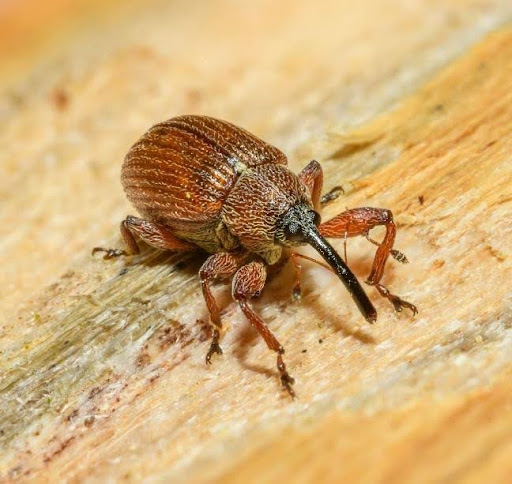
Weevils are small beetles belonging to the family Curculiondae, one of the largest and most diverse groups in the insect world. With found across nearly every continent and more than 60,000 known species, they are
habitat. Their distinctive appearance often featuring long snouts and elbowed antennae
makes them easy to recognize, even for casual observers. Most weevils are tiny,
typically ranging from two to ten millimeters in length. Their elongated snout, called a
“rostrum,” isn’t just for show. It houses mouth parts at the tip, allowing the insect to
bore into seeds, stems, nuts, and other plant material. This adaptation is key to how
weevils feed and reproduce: females often use the snout to drill holes in plant tissues
where they deposit their eggs. A weevil’s life cycle typically includes egg, larva, pupa,
and adult stages. For many species, the larvae stage is the most destructive. Hidden
inside seeds or plant tissues, the larvae feed and grow in protected environments, often
going unnoticed until damage becomes severe. Adults are usually herbivores as well,
feeding on leaves, stems, and grains. Weevils tend to be poor fliers or non-fliers,
depending on the species. Instead, they rely on crawling to find food and mates. Their
small size and ability to hide materials make them adaptable and hard to eliminate once
established. While some weevils are agricultural pests, many play roles in ecosystems.
They help break down plant matter, disperse seeds, and serve as food for birds,
spiders, and other predators. Like many insects, they contribute to the balance of
natural environments, even if some species cause challenges for humans.
Agriculturally, certain weevil species cause significant financial losses. The granary and
rice weevils can infest stored foods, leading to contamination and reduced quality. The
boll weevil, once one of the most destructive pests in North America, prompted large
scale eradication programs that reshaped cotton farming practices. Modern pest
management includes careful storage, temperature control, and integrated pest
management techniques, which combine monitoring, sanitation, and targeted
treatments to keep weevil numbers under control. Weevils may be tiny, but their
influence is surprisingly large, spanning ecosystems, agriculture, and even history.
Whether admired for their specialized biology or battled as crop pests, they remain one
of the most fascinating and widespread groups of insects on the planet.
Conservation Corner is a weekly article produced by the Forest County Land Conservation and
Land Information Department. For more information contact Lucas O’Brien, Forest County Land
Conservation Technician at 715-478-1387 or by e-mail at