
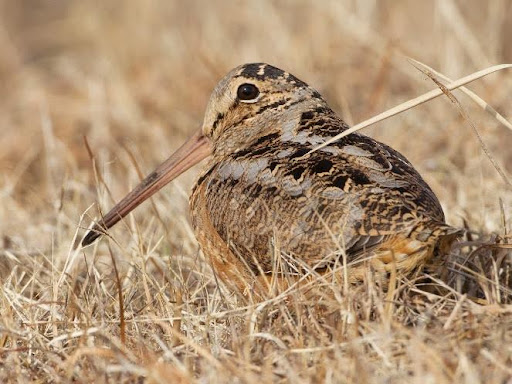
The American Woodcock is one of Northern Wisconsin’s most intriguing and elusive birds. Often overlooked due to its cryptic plumage and secretive habits, this small, rotund shorebird has adapted to life far from the coasts, thriving in the brushy woodlands and regenerating forests of the region. Its presence is a sign of healthy, diverse habitats, and its seasonal behaviors are woven into the ecological and cultural fabric of the Northwoods. The American Woodcock is instantly recognizable if you can spot it. Its mottled brown, black, and buff plumage blends seamlessly with the leaf litter of the forest floor, making it nearly invisible when still. The bird’s large eyes are set high and far back on its head, giving it an almost 360-degree field of vision, an adaption that helps it detect predators while feeding. Perhaps its most distinctive feature is its long, straight bill, which is flexible at the tip. This specialized tool allows the woodcock to probe deep into moist soil for earthworms, its primary food source. Sensitive nerve endings in the bill help it detect prey underground, a remarkable adaptation for a bid that forages largely by touch. These birds favor early successional forests- areas where young trees, shrubs, and dense underground dominate. These habitats often occur after logging, wildfire, or natural disturbance, and they provide the soft, moist soils the bird needs for feeding. One of the most remarkable aspects of the American Woodcock’s life in Northern Wisconsin is its spring courtship ritual, often called the “sky dance.” At dusk and dawn in April and May, males take to small open areas and begin with a series of nasal “peent” calls from the ground. Suddenly, they launch into the air in a spiraling ascent, their wings producing a distinctive twittering sound. At the peak of the flight, they hover briefly before tumbling back to earth in a zigzag pattern, resuming their calls. This display serves both to attract females and to establish territory. For many birdwatchers and naturalists, witnessing the sky dance is a seasonal highlight, signaling the return of spring to the Northwoods. The American Woodcock is more than just a curious woodland bird—it is an indicator species for a healthy mosaic of forest types. Its presence in Northern Wisconsin reflects a balance between mature forest preservation and the creation of young, brushy habitats. Without active management, these habitats disappear, and with them, the woodcock’s calls and aerial displays. Protecting the American Woodcock means protecting a whole suite of wildlife and maintaining the ecological diversity that defines the Northwoods.
Conservation Corner is a weekly article produced by the Forest County Land Conservation and Land Information Department. For more information contact Lucas O’Brien, Forest County Land Conservation Technician at 715-478-1387 or by e-mail at