
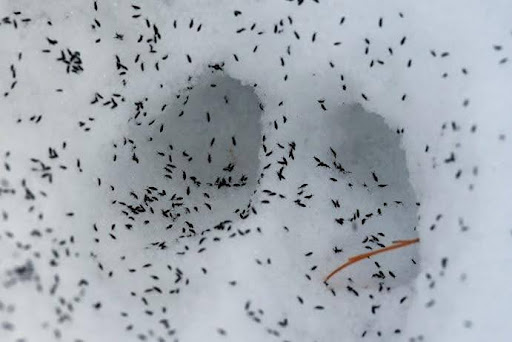
Winter landscapes often seem still and lifeless, with most insects hidden away until spring. Yet, on certain sunny days, you might notice the snow peppered with tiny
black specks that suddenly leap into the air. These are snow fleas, creatures that defy the usual rules of insect activity in cold weather. Despite their misleading name,
they are neither fleas nor harmful, but rather fascinating members of the winter ecosystem. Snow fleas are not true fleas, but
rather a type of springtail, small, wingless arthropods belonging to the order Collembola.
The species most commonly seen on snow in North America are Hypogastrura harveyi
and Hypogastrura nivicola. Measuring only 1-2 millimeters in length, they are almost
invisible against soil or leaf litter, but stand out dramatically against a snowy backdrop.
Springtails get their name from a unique forked appendage called the furcula, tucked
under their abdomen. When released, the furcula snaps downward, propelling the insect
into the air, much like a spring. This jumping ability is what inspired the “flea” part of
their common name. Snow fleas are active all year, but they are easiest to spot in late
winter or early spring. On mild days when snow surface softens, they emerge in large
numbers to feed. Their diet consists of mainly decaying plant matter, fungi, algae, and
microscopic organic debris. By breaking down this material, they help recycle nutrients
into the soil, a process that benefits plants and other organisms once the snow melts.
The reason they gather on snow is partly practical because the snow surface can be a
convenient meeting ground for feeding and possibly mating. The dark color of their
bodies also absorbs heat from the sun, allowing them to stay active in chilly air. One of
the most remarkable features of the snow fleas is their ability to remain active in
subfreezing temperatures. They produce antifreeze proteins that prevent ice crystals
from forming inside their bodies. This adaptation is similar to the antifreeze compounds
found in some cold-water fish and certain plants. Without it, their bodily fluids would
freeze, causing lethal damage to their cells. This biochemical trick not only allows them
to survive winter but also gives them a competitive advantage because few other small
arthropods are active in such conditions, meaning less competition for food. Snow fleas
are not harmful, they don’t bite, sting, or transmit diseases. They do not infest homes or
damage property. In fact, their presence is often a sign of healthy soil beneath the snow,
since they thrive in environments rich in organic matter. Gardeners and ecologists
consider them beneficial decomposers. Snow fleas are a reminder that the winter is not
as lifeless as it seems. These tiny, harmless creatures continue their work beneath and
atop the snow, recycling nutrients and sustaining the hidden web of life. The next time
you see dark specks hopping across a snowy field, you’ll know you’re witnessing one of nature’s small but remarkable winter survivors.
Conservation Corner is a weekly article produced by the Forest County Land Conservation and
Land Information Department. For more information contact Lucas O’Brien, Forest County Land
Conservation Technician at 715-478-1387 or by e-mail at