
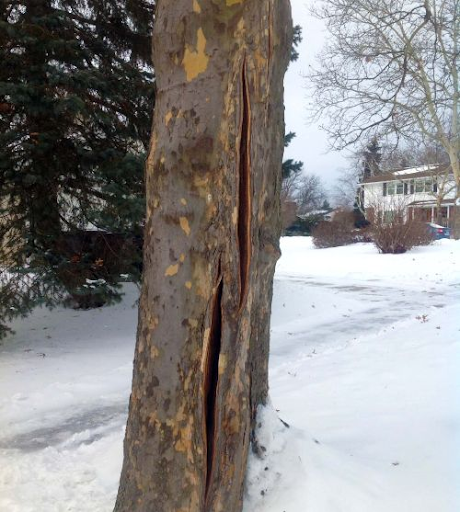
Winter can be a season of beauty, but for trees, it can also be a time of hidden stress. One of the most dramatic, and sometimes startling winter occurrences is frost cracks. This is a sudden split in a tree’s trunk that can make loud noises. While the term “exploding trees” occasionally makes headlines, the reality is less cinematic but no less fascinating. Frost cracks are usually vertically split along the bark and into the wood beneath. These cracks often appear during periods of extreme cold, especially when temperatures drop rapidly after a sunny winter day. The process is driven by thermal stress. During the daytime sunlight heats one side of the tree, causing the outer layers of wood to expand. Then at nighttime as temperatures drop, the outer layers contract faster than the inner wood, creating tension. This leads to a sudden release and puts stress on the tree, this stress exceeds the wood’s strength and this is when the trunk will split. Not all trees are equally vulnerable. One factor that plays a role in frost cracks is species susceptibility. Oaks, maples, and fruit trees are more prone to frost cracking compared to other trees. Another factor is age and size of trees. Mature trees with thicker trunks experience greater temperature differentials between inner and outer wood making it more prone to frost cracks. The last factor of frost cracking is due to exposure. Trees on the south or southwest side of open areas receive more winter sun, increasing their thermal stress. While a single frost crack doesn’t always spell doom for a tree, it can have long term consequences which include structural weakness, entry points for pests and disease, and a reduced life span for the tree. Frost cracks are a vivid reminder that trees, though seemingly still and silent, live in constant negotiation with their environment. They endure cycles of stress and recovery, adapting to the seasons in ways both visible and hidden.
Conservation Corner is a weekly article produced by the Forest County Land Conservation and Land Information Department. For more information contact Lucas O’Brien, Forest County Land Conservation Technician at 715-478-1387 or by e-mail at