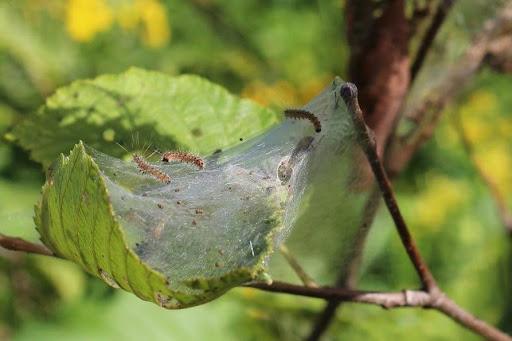
Fall webworms are a common moth in the tiger moth family (Erebidae) and native to North America. In Wisconsin, they are most noticeable from late July through September, when caterpillars feed inside large, loosely constructed silken nests at the tips of branches. Common host trees include walnut, elm, hickory, birch, black cherry, box elder, and crabapple. Adult moths emerge in early spring to summer, laying eggs in hairlike masses on the underside of leaves. Larvae spin webs and feed inside, enlarging the nest as they grow. They reach about one inch in length, with pale green or yellow bodies, a dark central stripe, and long silky hairs. In Wisconsin, there is usually one generation per year. Unlike spring emerging pests such as eastern tent caterpillars or spongy moths, fall webworms feed when trees are already reducing foliage for the season. The Wisconsin DNR notes that healthy trees generally tolerate the damage well, and the webs are mostly a cosmetic issue. Wind and rain often break down nests within a few months. Fall webworm tents are always at the end of a branch, and the caterpillars feed inside the web (unlike eastern tent caterpillars, which feed outside). They also appear in late summer/fall. For most property owners, no action is needed. If removal is desired for aesthetic reasons there a few ways to manage and control fall webworms. The first is mechanical removal, which you can do by exposing the nest to let the caterpillars be exposed to natural predators. You can also do chemical removal by applying insecticide to the nest, if necessary, avoid pruning the branch as this can cause more harm than the caterpillars. Fall webworms are a seasonal, and mostly harmless insect. They are a visual curiosity than a serious pest, and leaving them alone is usually the best approach. Keep an eye out for these nests as there are still a few around in the area.
Conservation Corner is a weekly article produced by the Forest County Land Conservation and Land Information Department. For more information contact Lucas O’Brien, Forest County Land Conservation Technician at 715-478-1387 or by e-mail at