
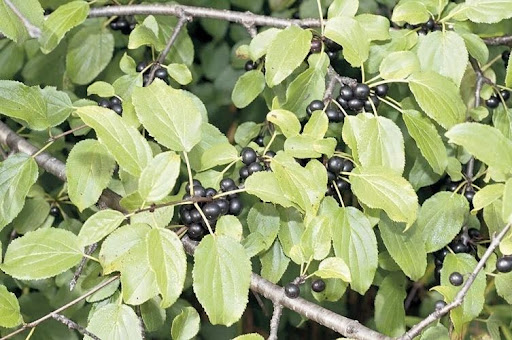
Common buckthorn, also called Carolina or European buckthorn, is a dioecious (male and female plants separate) understory shrub or small tree reaching 10-25ft in height. The small tree invades oak forests, riparian woods, savannas, prairies, old fields, and roadsides. Its late fall leaf retention gives it a longer growing season than native plants, and it produces dense shade that eliminates seedling regeneration. It is also allelopathic, which means it releases chemicals that inhibit other vegetation. Birds and mammals disperse its black, pea sized fruits widely. There’s a few different ways you can identify buckthorn and one of them is by the leaves. The leaves are usually 1-2.5 inches long with tiny teeth on them. Leaves on buckthorn can also stay green into fall. Another way to identify buckthorn is the fruit they have which are clusters of round, black fruits they produce in late summer and persist into winter. Bark on buckthorn is also a great way to identify the small tree. The bark is a gray to brown color with light lenticels and if you cut into the bark, it will show a yellow sapwood and/or orange heartwood. Most of the time buckthorn spreads through seed dispersal by wildlife and root systems. It is also planted as an ornamental hedge but escapes into natural areas. There are a few different ways to get rid of buckthorn whether its mechanical treatment or chemical. Recently our office was able to help out at the Laona School Forest where students helped with the removal of buckthorn in the forest. Buckthorn in the forest was managed with the cut-stump method which involves cutting the tree as low to the ground as possible and then applying herbicide to the stump immediately to ensure absorption before the stump seals its vascular tissue. After removal of buckthorn, it is important to plant native tree species to restore understory regeneration or to just keep an eye out on the treated areas to make sure there is no buckthorn regeneration the following years. Overall, buckthorn thickets degrade forest health, reduce biodiversity, and hinder recreational and ecological access. Control is ongoing in Wisconsin, with multiple projects showing that combined mechanical, chemical, and restoration methods can restore habitat.
Conservation Corner is a weekly article produced by the Forest County Land Conservation and Land Information Department. For more information contact Lucas O’Brien, Forest County Land Conservation Technician at 715-478-1387 or by e-mail at