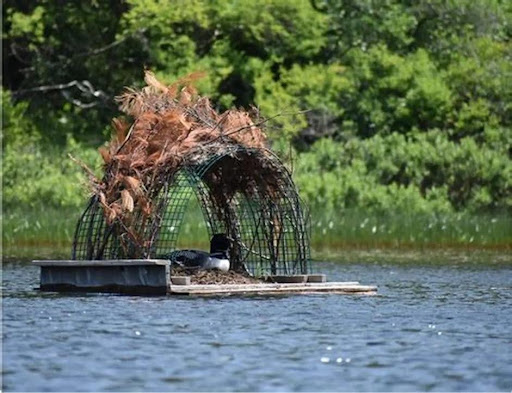
Across North America’s northern lakes, the call of the common loon is a cherished sound of summer. These birds when fully mature can get up to 27-29 inches long with a wingspan of roughly 4 feet. They have a stocky build, a pointed bill, and feet that are set back far on their bodies making them excellent swimmers, but also making it difficult for them to be on land. Loons prefer cold, clear lakes and are often found near shore. Yet, these iconic birds face increasing challenges when it comes to nesting. Rising and falling water levels, shoreline development, and human disturbance threaten their ability to raise chicks successfully. To counter these pressures, conservationists have turned to an innovative solution: man-made loon nests, also known as floating nest rafts. Loons typically build their nests right at the water’s edge, where they can slip directly into the lake to escape predators. However, this strategy makes them vulnerable to water level fluctuations, shoreline development, and human disturbance. Man made loon nests are typically a floating platform constructed from materials like cedar logs, PVC pipe, or recycled plastic, topped with vegetation such as sedges, grasses, or moss. The design allows the raft to rise and fall with water levels, provide stable/predator resistant sites, and blend into the environment. Some of these rafts are anchored in sheltered bays to reduce wave action, while others are placed near traditional nesting territories to encourage use. While these man made nests can boost reproduction, they don’t cure all the challenges. Conservationists must monitor rafts annually to ensure they remain safe and functional, avoid placing them in areas with high boat traffic, and address root causes of habitat loss such as shoreline development and pollution. Whether through volunteering, supporting conservation groups, or simply giving nesting loons space, each of us can play a role in ensuring these remarkable birds remain a living part of our waters.
Conservation Corner is a weekly article produced by the Forest County Land Conservation and Land Information Department. For more information contact Lucas O’Brien, Forest County Land Conservation Technician at 715-478-1387 or by e-mail at