This story is courtesy of the Vilas County News Review.
Vilas and Oneida counties have received more than $1.1 million in grant funding to help combat, prevent and study aquatic invasive species (AIS) in local waterbodies.
The funding comes as part of Wisconsin DNR’s approximately $6 million that was recently awarded to lake organizations, nonprofit organizations and municipal and county governments throughout Wisconsin. This grant program provides cost-sharing for projects that restore and protect surface water; defined as all water open to the atmosphere, including rivers, streams, lakes, ponds, impoundments and wetlands.
According to the DNR, this year the program received 471 applications from eligible applicants requesting nearly $7.3 million. Of the applications received, 426 grants were awarded, totaling more than $6.1 million.
The projects are incredibly diverse, including education and outreach activities, management planning, habitat restoration, runoff management, water quality improvement projects, and AIS prevention and management.
“It is always rewarding to see implementation and restoration projects get funded that will have a long-lasting positive impact on our water resources,” said Michelle Nault, Wisconsin DNR lakes and rivers section manager. “The projects selected for award leverage substantial local funding and commit to making significant contributions to Wisconsin’s natural resource legacy.”
Funding for area organizations
Local funds will help groups like Vilas County Land and Water Department (VCLW), North Lakeland Discovery Center (NLDC), Town of Plum Lake, Three Lakes Waterfront Association and others continue to spread awareness, as well as prevent and study AIS.
In Vilas, more than $578,000 was awarded, while Oneida received over $341,000. Nearly $215,000 also was awarded for projects in both counties, including work on the 28-lake Chain that extends across Eagle River and Three Lakes, as well as a UW project focused on ecosystem effects of EWM.
A number of lake groups in both counties received significant funds toward the Clean Boats Clean Waters (CBCW) initiative, including Three Lakes Waterfront Association which netted $12,000. The organization also received nearly $30,000 for continued environmental monitoring on Long, Planting Ground and Range Line lakes as part of the AIS Planning grants awarded.

NLDC’s Woods and Water Program received $180,000 in funding through six grants from the DNR, according to Abby Vogt, director of the program. In addition, NLDC also is partnering with the Manitowish Waters Lakes Association on another four grants.
Vogt explained that funds will be used on the Manitowish Chain of Lakes, as well as lakes within the Town of Winchester.
“In Winchester, we received funds through three grants to update aquatic plant data, monitor invasive species, and educate the public around invasive species and healthy lakes. This will take place on Helen, Adelaide, Circle Lily, and Pardee lakes,” she said. “These projects are important to continue to update aquatic plant data to have a better understanding of plant communities in the lake and any potential risks the lake may face. We continuously monitor for invasive species year after year, and these efforts are vital for detecting pioneering populations.”
NLDC also received funding for CBCW at Rest and Clear Lake boat landings, to inform boaters about preventing the spread of invasive species.
“This year, we also received a grant to utilize a decontamination station at the Rest Lake boat landing,” Vogt added. “This will allow NLDC staff to decontaminate boats entering and leaving Rest Lake, with owner permission. Through this grant, we will also educate about invasive species spread and the importance of decontamination of boats.”
Finally, NLDC received funding for a large-scale control grant to remove Eurasian watermilfoil (EWM) from the Trout River and Manitowish Lake.
“This species was detected in 2023 and has since spread from the initial area of detection. This grant will allow for continued removal and monitoring efforts of EWM in these waterbodies, while also gaining a better understanding of the distribution and density of EWM through surveys,” Vogt said.
Plum Lake projects
Nearby in the town of Plum Lake, grant awards totaled $67,294 for various lake conservation projects. The largest project is for the CBCW program with a grant of $23,944.
Bob Jackson, chair of the Town Lakes Committee, said this is one of the oldest grant programs administered under the DNR’s Surface Water Grants program. Plum Lake has participated in the program since 2010 and has received the largest grant under the program in a number of years.
The CBCW program is for inspection of watercraft at boat landings.
“Specifically, the grant pays for inspectors to attend a training workshop early in the boating season and the inspectors conduct inspections, provide aquatic invasive species information, collect, and report data and report suspect specimens to a DNR database,” he said.
Inspectors are deployed to landings on Plum, Star, Ballard, Laura, Irving and Razorback lakes over the summer and fall with the goal of preventing the spread of AIS.
Jackson said the town had previously installed video monitoring systems on these landings. The system consists of a camera at ground level and advanced sensors that tell when a boater has entered the launch area and turns on video monitoring of the bottom of the boat and the boat trailer to detect whether aquatic plants are present.

The system also has audio capability and can broadcast up to five different messages, reminding the boater to clean and inspect the boat and trailer prior to launch, draining water from bilge, baitwell and motor and informs the boater of the use of video surveillance technology. The systems were partially funded by the DNR.
The video monitoring provides daytime hours coverage for each landing and reminds boaters of their responsibilities when in-person monitors are not present. Jackson said the Town Lakes Committee receives information on the review of the videos recorded each year.
“We believe prevention is critical to maintaining the health of the town lakes,” he said. “The CBCW program and the video monitoring systems remind boaters to keep their boats clean.”
Jackson stated that lake care is important as the town’s most valuable property is lakeshore property. In fact, according to Doug Pinney, treasurer of the Town Lakes Committee, 67% of the town’s tax base was recently accounted for by property with deeded access to one lake — Plum Lake.
He further noted that DNR grants had partially funded other committee projects, including surveys of small lakes to identify aquatic health, remediation of Little Star Lake to hand-pull EWM, and placing “fish sticks” (bundles of down trees that promote fish-habitat) in town lakes. The fish stick program is administered by the Vilas County Land and Water Conservation Committee.
“New for 2026 is a grant that supports the mapping of a hybrid EWM identified in 2025 on Plum Lake,” Jackson said. “Also for 2026, the DNR awarded grants for surveys of vegetations and monitoring of aquatic invasive species on Irving, Ballard, White Birch and Laura lakes.”
The surveys were anticipated in the comprehensive Town Lakes Management Plan completed in 2022 with a grant from the DNR. The surveys are being completed over the summers 2025-2027.
“The surveys of vegetation and monitoring of lakes allows the lakes committee to quickly respond to any negative changes. The DNR is an important partner in our committee’s activities,” Jackson said.
County initiatives
VCLW will have many projects funded in Vilas County this year thanks to these grants, ranging from CBCW to AIS planning, control, education and prevention. Also funded are different lake education projects targeting shoreline care, lake planning and a wild rice project.
Cathy Higley, lake conservation specialist with VCLW, highlighted some of the projects she’s most excited about.
“Using Lake Monitoring and Protection Network funds, we’ll be working on surveying about eight specific lakes and rivers in Vilas County for invasive species; offering outreach programming on lake ecology; inventorying and offering updated boat landing signage; participating in a boater behavior study; offering some CBCW shifts on targeted lakes; and assisting with purple loosestrife biocontrol,” she said.
As part of the CBCW program, the county is ordering a modest number of towels which inspectors at boat landings offer to boaters, encouraging them to clean and dry their boat and equipment.
Using AIS Prevention funding, staff also is again doing outreach to boaters in the western portion of the county. “We’ll be offering hot water decontamination free to boaters at Big Muskellunge, Plum, Star, and Trout lakes every other weekend this summer, and doing more outreach on preventing spiny waterfleas,” she said.
VCLW also is forming new partnerships to stop the spread of non-native phragmites, which can harm shorelines and wetlands by choking out native plants. Higley said VCLW has been working with the highway department in order to train road crews on phragmites prevention and reporting of suspected phragmites. Some funding also will be dedicated to a billboard promoting phragmites prevention.
“We worked last year with the highway department and the Town of Conover on some phragmites prevention efforts,” Higley noted. “We are hoping to do a repeat training, as I am sure there will be some new staff come spring.”
VCLW will use AIS early detection methods to survey eight waterbodies using snorkeling at some sites and boat landings, as well as a meander survey in watercraft around the lake’s shoreline.
A few of the waterbodies will be looked at primarily for phragmites, including Lake Laura, wetlands around Little Tamarack Creek downstream of the dam near Little Tamarack Flowage, and Razorback Lake. Other surveys will include Lake of the Hills; Pioneer Lake; and Pioneer Creek between Pioneer Lake and Church Road, and Twin River between Pioneer Lake and Monheim Road, both near Conover.
Another lake will be determined later in the season, Higley said, depending on coordination efforts with lake groups. Surveying is also planned on Spectacle Lake, but that money is from a different DNR grant cycle.
From the Lakes Education funds, VCLW is working with several partners to update and send brochures to all new shoreline owners about shoreline regulations, best practices, and where they can find help navigating how to manage their shoreline.
“We also leave a little wiggle room for one or two extra surveys for things that come up during the summer so we can help where needed,” Higley said. “And that’s just the projects that DNR awarded this year. We have a lot more going on this summer that is DATCP (Department of Agriculture, Trade and Consumer Protection) or county tax levy-funded, or funded by DNR in a different grant cycle.”
Al Wirt, VCLW director, was responsible for securing grant money this cycle to collect data on historic wild rice systems in Vilas County. This is a three-year grant ending Dec. 31, 2028.
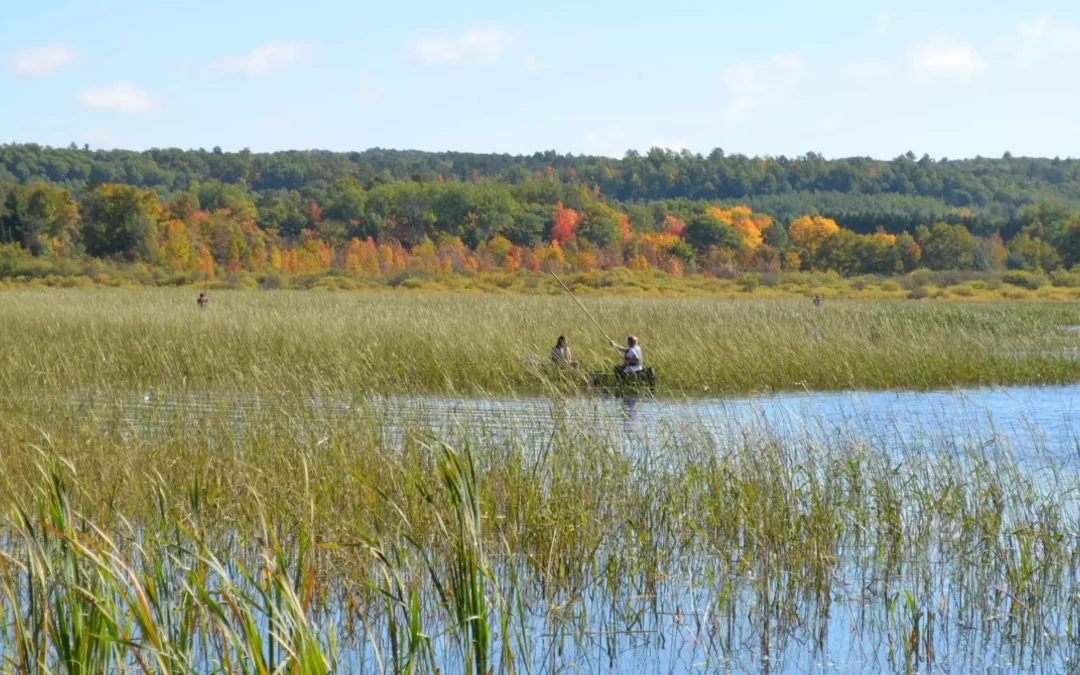
Wirt explained that the project will include 15 bodies of water that have current or historically had populations of wild rice (Zisania palustris). Thirteen of those were chosen by the Lac du Flambeau Tribe as having high significant value, and the other couple were picked by the DNR due to water quality concerns in those systems.
“This is phase one of what I hope to be a long-term trend data collection, and, in this phase, we will be collecting water temp and depth changes from ice-off until ice-on to try to catch all changes within the cycle of wild rice,” Wirt said.
The importance of the wild rice in Vilas County has many levels, from the cultural significance to the ecological importance in a large part in the county.
“Wild rice is struggling and a lot of research is going into why, but there are some gaps in that research and with this project, I hope will fill in some of those missing pieces,” Wirt said.
The project is quite an undertaking, using specialized equipment to gather data.
“We will be utilizing HOBO MX loggers that will be mounted on 8-foot posts driven into the lakebed. These loggers can measure at predetermined intervals and store that data until downloaded,” he said. “Future phases will include water sampling events that could help identify potential impairments or even highlight extremely healthy systems.”
Higley said these grant cycles are “no small endeavor” and take a lot of planning and organizing by lake groups, but highlighted their overall importance.
“I am very grateful for being able to offer projects like the ones we do for the benefit of people and lakes of Vilas County. Without the DNR Surface Water Grant program, our work would be less robust. I am definitely not bored at work!” she said.
These projects are just a few examples from the organizations and communities receiving funding this year. Local organizations that could benefit from a surface water grant are encouraged to reach out now to determine eligibility and begin developing ideas before the September 2026 pre-application deadline.
For more information, to find a Surface Water Grant project in your community, or to see a full list of this year’s projects, visit dnr.wisconsin.gov/aid/surfacewater.html.